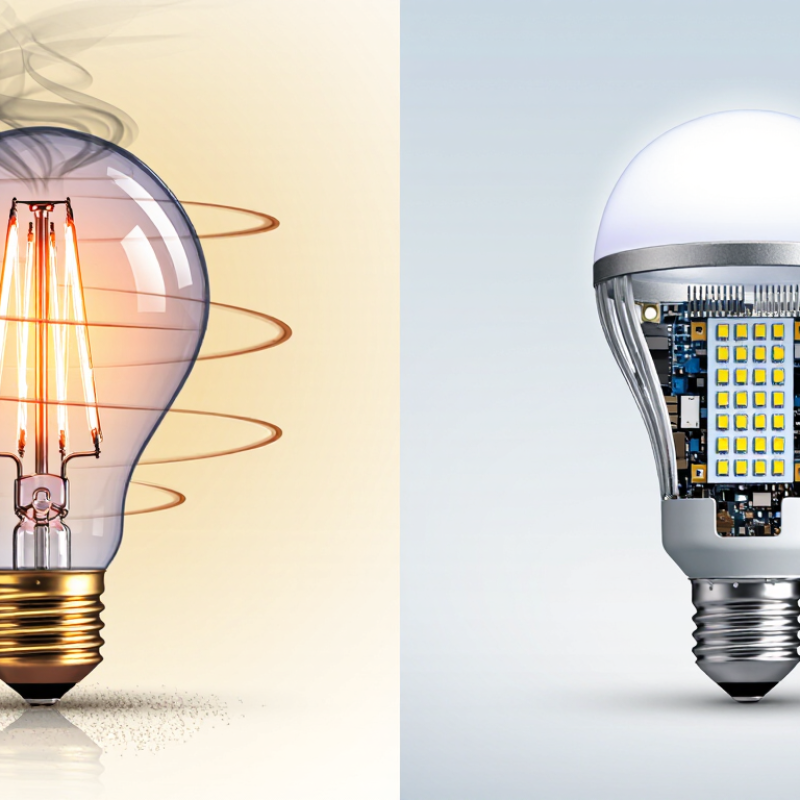
Why Do LED bulbs last longer than incandescent bulbs? The answer begins inside the bulb. An incandescent bulb sends current through a thin tungsten filament. It glows, but it also gets extremely hot. Over time, tungsten evaporates from the filament, leaving it thinner and weaker. One day, often with a small flash, it breaks. An LED works differently. A semiconductor produces light without relying on a glowing wire, so it avoids that same failure point.
Lighting researcher Dr. Michael Siminovitch’s perspective can be paraphrased this way: “Managing heat is essential to keeping an LED working for years.” That is not a verbatim quotation. It captures an important engineering detail: LEDs still generate heat, and their electronic drivers and components can wear down. A poorly designed bulb trapped in a hot, enclosed fixture may fail sooner than its package suggests.
The comparison is useful, but it can oversimplify things. LED life ratings usually describe how long a bulb maintains useful light, not a guarantee that every bulb will keep shining until a precise date. Incandescent bulbs often fail suddenly; LEDs may grow dimmer gradually. Quality, operating temperature, and daily use all matter. So do the small details: the fixture above a kitchen sink, a tightly enclosed porch light, or a bulb switched on and off repeatedly. LEDs generally last much longer because their light-producing parts avoid the incandescent filament’s intense heat and gradual weakening. Still, the label is only part of the story. A longer-rated bulb can disappoint when its design or conditions are poor.
How Incandescent Bulbs Produce Light
An incandescent bulb makes light by heating a thin tungsten filament. When electricity flows through it, the filament resists the current and grows extremely hot, often above 2,500°C. At that temperature, it glows. The familiar warm light comes from this heat, not from a chemical coating or a small flame.
Inside the glass envelope, a vacuum or an inert gas slows the filament’s deterioration. Still, tungsten atoms gradually evaporate from the wire. Some settle on the glass, creating a faint gray or black film. The filament also becomes thinner, especially at weak points, until it breaks. Then the bulb goes dark. A small detail matters: switching on a cold bulb can briefly stress the filament, since it heats rapidly and its electrical resistance changes as it warms. This is one reason frequent switching may affect its life, though conditions vary. The mechanism sounds simple, but the heat is largely wasted as infrared radiation. That trade-off is easy to overlook when watching the filament glow.
Why Do LED Bulbs Last Longer Than Incandescent Bulbs?
Typical rated lifespan comparison
An incandescent bulb produces light by heating a thin tungsten filament until it glows. This also releases much of its energy as heat, gradually wearing out the filament. An LED produces light using a semiconductor, which generally wastes less energy as heat and can last much longer. Lifespans shown are representative ratings; actual performance varies by bulb and use.
How LED Bulbs Produce Light
Inside an LED bulb, light begins at a semiconductor junction, not a glowing wire. Electric current moves electrons across the junction, where they meet positively charged “holes.” When they recombine, they release energy as photons. The chip’s materials determine the photons’ wavelength—and therefore their color. That is the trick.
Most household white LEDs use a blue-emitting chip and a phosphor coating. The phosphor absorbs some blue light and re-emits it across other wavelengths; the combined light appears white. A small driver circuit controls current, while internal metal parts carry heat away from the chip. Heat still matters. I find it easy to oversimplify this point: LEDs run cooler than incandescent filaments, but they are not heat-free. Poor heat management can shorten component life.
The U.S. Department of Energy’s LED lighting guidance reports that residential LEDs use at least 75% less energy and can last up to 25 times longer than incandescent bulbs. The different light-making process helps explain why: an LED does not rely on a fragile filament heated until it glows. Its semiconductor and electronics can still degrade, especially under excess heat or unstable current. The DOE figures are broad comparisons, not a promise for every bulb or fixture.
How Heat and Electrical Stress Affect Bulb Lifespan
Why Do LED Bulbs Last Longer Than Incandescent Bulbs?
An incandescent bulb produces light by heating a tungsten filament until it glows. Much of that energy becomes heat. The U.S. Department of Energy estimates incandescent bulbs release about 90% of their energy as heat. Repeated heating and cooling gradually weakens the filament. A small bump can finish the job. Short life, in plain terms.
LEDs use semiconductor chips, not glowing wires, so they waste less energy as heat. But they still need to shed heat through the bulb’s base. Hot, enclosed fixtures can accelerate wear on the LED and its driver, which converts household current. Voltage spikes and incompatible dimmers can also stress that driver. The U.S. Department of Energy’s LED lighting guidance reports that LEDs use at least 75% less energy and can last up to 25 times longer than incandescent bulbs. These are broad comparisons, not promises for every fixture. Real rooms are messier than test conditions.
Tips: Keep bulbs clear of insulation, choose dimmer-compatible LEDs, and check whether an enclosed fixture is suitable. If a bulb fails early, heat or electrical stress may be part of the story.
Why Incandescent Filaments Fail Over Time
An incandescent bulb’s filament is a thin tungsten wire, heated until it glows. Each time the switch is turned on, the wire heats rapidly; when switched off, it cools and contracts. Repeated cycles strain the filament. That matters.
At operating temperature, tungsten atoms slowly evaporate from the wire. The filament becomes thinner, especially at small imperfections, and its electrical resistance and temperature can rise unevenly. Eventually, one weakened section breaks, often with a brief flash. Vibration or a jolt can hasten failure, but ordinary use alone gradually wears the wire down.
The U.S. Department of Energy’s Energy Saver guide puts a typical incandescent bulb’s life at about 1,000 hours. That estimate reflects a familiar failure pattern: the bulb keeps working until its fragile filament opens. LEDs avoid this hot, exposed wire, though their drivers and heat management can still limit service life. Rated life is an estimate, not a promise; switching habits and fixture conditions can change the outcome. I used to think the glass was the vulnerable part. Usually, it is the tiny wire inside.
How LED Components Extend Operating Life
An incandescent bulb makes light by heating a thin tungsten filament until it glows. Repeated heating slowly evaporates tungsten, thinning the wire until it breaks. An LED works differently: a semiconductor emits light when electric current passes through it. It does not depend on a fragile, glowing wire, so ordinary switching causes less wear on its light-producing element.
The supporting parts matter, too. A small driver converts household current into power the LED can use. Its electronics can age, especially when heat builds inside a closed fixture. Heat can also stress the LED chip and reduce brightness over time. Good thermal design moves heat away through the bulb’s base and housing. A well-designed LED may keep working for years, though actual life depends on temperature, ventilation, and daily use. It is easy to think “long-lasting” means “unchanging,” but an LED may grow dim before it stops lighting.
Tips: Choose a bulb rated for enclosed fixtures when needed, and keep vents clear. Match its brightness and dimmer compatibility to the fixture. If the base feels unusually hot, check airflow; heat is a useful clue, not a precise life test.
Why Do LED Bulbs Last Longer Than Incandescent Bulbs? — How LED Components Extend Operating Life
| Dimension |
Incandescent Bulb |
LED Bulb |
How This Affects Operating Life |
| Typical rated life |
About 1,000 hours for a common household bulb; actual ratings vary by bulb type. |
Many household LED bulbs are rated for approximately 15,000–25,000 hours, with some rated higher. |
LEDs can provide many more rated operating hours, although results depend on product design and use conditions. |
| Light-producing component |
A thin tungsten filament glows when heated by electric current. |
Semiconductor diodes produce light when current passes through them. |
An LED has no hot filament that gradually evaporates and eventually breaks, removing a common failure mechanism. |
| Heat and temperature |
The filament operates at a very high temperature; heat contributes to tungsten evaporation and filament wear. |
The LED chip produces heat that must be conducted away, typically through a thermal path and heat-spreading parts. |
Good heat management helps limit LED chip and component temperatures. Excessive heat can still shorten LED life. |
| Typical end-of-life behavior |
Often stops producing light when its filament breaks. |
Light output commonly declines over time; the bulb may stop working if its LED chip or electronic driver fails. |
LED life ratings often describe gradual light-output maintenance rather than a precise moment when every bulb fails. |
| Electronic driver |
Does not use the electronic driver circuit found in an LED bulb. |
Uses a driver to convert and regulate electrical power for the LEDs. |
The driver is an important LED component and can limit overall bulb life, especially if it is exposed to high heat or electrical stress. |
| Switching and vibration |
Repeated switching and vibration can stress or damage the fragile filament. |
Has no filament to break, though its electronics and construction can still be affected by electrical stress, vibration, or poor connections. |
The solid-state light source is generally less vulnerable to filament-related damage, but the full bulb is not immune to failure. |
| Conditions that affect life |
Frequent switching, vibration, and operating conditions can affect filament life. |
High ambient temperature, enclosed fixtures, poor ventilation, voltage conditions, and driver quality can affect life. |
Using a bulb in a suitable fixture and following its operating instructions helps it reach its rated life. |
Note: Rated-life figures are not perfectly interchangeable. Incandescent life is commonly stated as an average or median time to failure, while many LED ratings use a light-output maintenance measure such as L70—the estimated time until output falls to 70% of its initial level. Actual performance varies by bulb and operating conditions.
Conclusion
Why do LED bulbs last longer than incandescent bulbs? The answer lies in how each type produces light. An incandescent bulb sends electricity through a thin filament, heating it until it glows. An LED creates light through a semiconductor, without needing to heat a filament to extreme temperatures. This difference means incandescent bulbs lose more energy as heat, while LEDs generally produce less heat during operation.
Heat and electrical stress gradually weaken incandescent filaments. As the filament repeatedly heats and cools, its material wears away and may eventually break, ending the bulb’s life. LEDs avoid this fragile component, so they are less vulnerable to that particular form of failure. Their lifespan still depends on the condition of their electronic components and how well heat is managed, but these parts can support long periods of use. Together, the more efficient light-producing process and the absence of a glowing filament help explain why LEDs typically last longer.

 Luma Bulb