LED pendant lights can bring focused illumination and a clean, modern look to kitchens, dining rooms, and entryways. Yet a polished product photo does not show whether a fixture suits your ceiling, wiring, or room dimensions. A pendant that hangs too low can obstruct a walkway. One that is too small may leave a dining table dim. Small details matter.
When comparing China-made LED pendant lights, check the product specifications, certifications, driver compatibility, dimming options, and warranty terms. Confirm the fixture’s weight and mounting requirements before ordering. A sturdy ceiling box matters. So does the correct suspension length. Warm or cool light can also change how paint, wood, and food appear. These choices are easy to overlook when shopping online, and even experienced installers sometimes miss a measurement.
How to avoid common installation mistakes with LED pendant lights? Start by planning the location and hanging height, then verify that the existing ceiling support and electrical supply match the manufacturer’s instructions. Do not rely on guesswork for wiring or load capacity; use a qualified electrician when the work requires electrical expertise. Test the light and dimmer for compatibility before final assembly, and keep the installation guide available. This guide explores practical checks, frequent errors, and product details worth confirming before installation. Not every room follows a perfect plan. A final measurement can still save time, money, and frustration.
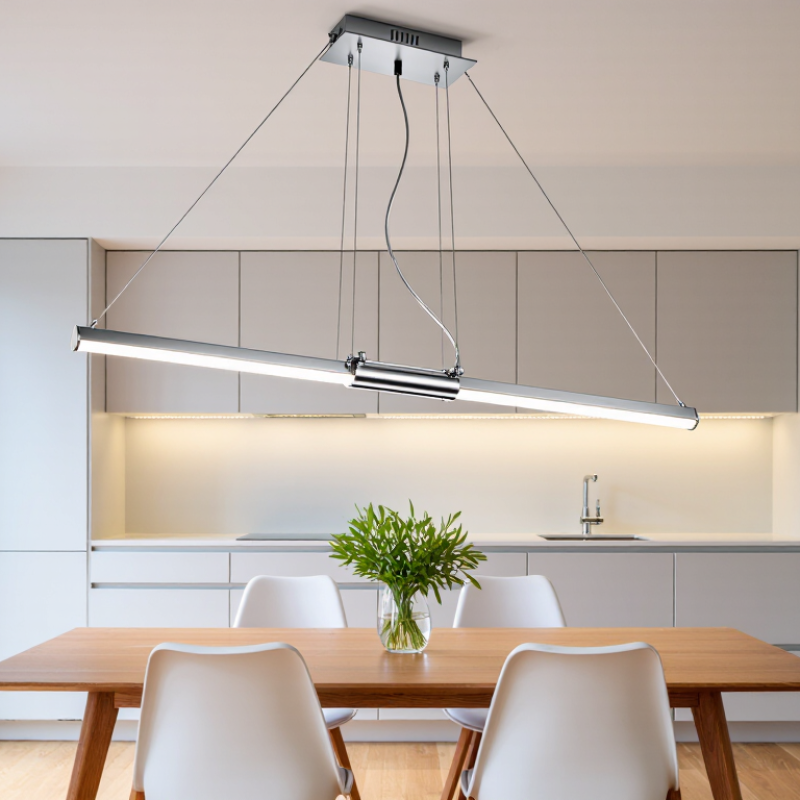
LED pendants generally use replaceable bulbs or integrated LED modules. Bulb-based designs are easier to service, while integrated models often allow slimmer shapes. Some pendants provide focused light over a table; others spread softer light across a room. Check product diagrams, not just polished photos. A narrow shade may leave dark corners.
Compare lumen output, color temperature, and color rendering index (CRI). Lumens indicate brightness; wattage alone does not. Warm white, around 2700–3000K, can feel comfortable above a dining table. A CRI of 90 or higher helps food and wood tones look more natural. Also confirm dimmer compatibility, input voltage, and fixture dimensions. I’ve seen ceiling height overlooked: a beautiful pendant can hang too low above a busy walkway.
Tips: Measure the table and ceiling before choosing. Leave enough headroom, and check the canopy size against your ceiling box. Ask for a specification sheet showing tested output and dimming details. Small detail, big difference. If the sheet is vague, pause and verify; guessing is not a specification.
When evaluating Chinese pendant-light manufacturers, look beyond catalogue photos. The IEA’s Tracking Clean Energy Progress 2023 reports that LEDs account for roughly half of global lighting sales. That makes consistent production and transparent testing especially important. Ask for dated test reports matching the exact model, LED module, and driver—not a similar product. Check color temperature, color-rendering index, flicker, power factor, and dimming behavior. Request a sample and inspect its canopy, cable strain relief, finish, and heat around the driver after several hours. Small details matter.
The U.S. Department of Energy’s 2019 Energy Savings Forecast of Solid-State Lighting projected annual U.S. electricity savings of 569 terawatt-hours by 2035, compared with its baseline. That estimate concerns energy savings, not product quality, so do not confuse efficiency claims with proof of reliability. Ask how the factory tracks defects and handles repeat orders; compare production samples with the approved sample. A polished sample can still mislead. I would also verify applicable safety and performance documentation for the destination market, and confirm who conducts the tests. Paperwork helps, but I once overlooked a driver substitution risk; written change-control terms would have caught it.
A pendant light should suit the work happening below it, not just the room’s style. Over a kitchen island, check that the light reaches the full countertop without shining directly into someone’s eyes. A single fixture may leave the ends dim; two or three smaller pendants can spread light more evenly. Measure the surface and ceiling height before choosing. Small details matter.
Color changes how a space feels. Warm white light often makes timber and dining areas feel inviting, while a more neutral white can help with food preparation or focused tasks. Check the fixture’s color rendering information too; poor rendering can make ingredients and finishes look dull. If the pendant will serve several purposes, a compatible dimmer offers useful flexibility. Test the setting in the actual room, if possible. A showroom can be misleading.
The design should balance the furniture beneath it. A broad shade may overwhelm a narrow table, while a tiny pendant can look lost above a long island. Match finishes with nearby materials, but avoid making every metal detail identical. That can feel forced. One easy mistake is selecting by product photo alone: shade size, ceiling height, and surrounding daylight can change the result. Even careful planning misses something. Leave room to reassess the layout before installation.
Pendant lights can look balanced in a showroom but feel oversized above a small dining table. Measure the table and ceiling height before choosing a fixture. As a practical guide, a pendant often works best when its width is about one-half to two-thirds of the table’s width. Leave roughly 30 to 36 inches between the tabletop and the light, then adjust for tall users or a low ceiling. Measure twice. I have still misjudged a room by relying on photos; they hide proportions.
Check the wiring before installation, not after unpacking. Confirm that the ceiling box can support the fixture’s weight and that the circuit is switched off at the breaker. LED drivers and dimmers must be compatible, or the light may flicker or fail to dim smoothly. If wiring colors, grounding, or the existing circuit are unclear, ask a qualified electrician. Guessing is not a shortcut.
For installation, mark the table’s center and align the canopy above it. A crooked pendant is easy to notice, especially over a rectangular surface. Tighten fittings securely, but do not force screws or pinch wires inside the canopy. Keep the installation instructions nearby. One small oversight can mean taking the fixture down again, which is frustrating—and avoidable.
A pendant light can look flawless in a showroom and still disappoint after installation. Check that the safety certification matches the exact model, voltage, and driver—not merely a similar-looking product. Ask for the certificate number and verify it through the issuing testing organization. A printed logo alone is weak evidence. Keep the technical sheet and invoice together; you may need both when reporting a fault.
Read the warranty’s exclusions before ordering. Does it cover the LED module, driver, finish, and labor, or only selected parts? The U.S. Department of Energy’s Energy Saver guidance says LEDs can use up to 90% less energy and last up to 25 times longer than incandescent bulbs. That comparison concerns bulbs, not a whole pendant fixture, so it should not replace a written fixture warranty. Ask how long replacement parts take to arrive and who pays shipping. Get the answer in writing.
After-sales support matters. Request a named contact, response-time expectations, and a process for sending photos or test records. Keep a short installation video, especially if the light flickers or hums. Small detail. I once assumed “long life” meant easy repair; it did not. Check whether the driver is replaceable, and whether spare parts will remain available. A clear answer is reassuring. Silence is useful information too.
| Area | Common Mistake | What to Check | Useful Evidence | Why It Matters |
|---|---|---|---|---|
| Market requirements | Assuming one certificate or marking is valid for every destination market. | Identify the destination country and product category first. Confirm which electrical safety, EMC, energy-efficiency, and substance-restriction requirements apply. | Written compliance checklist for the destination market; product-specific test reports and declarations where applicable. | Requirements and conformity-assessment routes vary by market and product. |
| Safety documentation | Accepting a logo or a generic certificate without checking its scope. | Check that the document identifies the exact model or product family, relevant ratings, applicable standard, issuing body, and validity or revision details. | Complete certificate or report, model list, and matching product label or datasheet. | Documentation for a different model or configuration may not establish compliance for the product being purchased. |
| CE and declarations | Treating the CE mark alone as proof of independent third-party certification. | For products placed on the EU market, ask for the applicable EU Declaration of Conformity and supporting technical documentation. Check the legislation and standards cited against the product and intended use. | Signed EU Declaration of Conformity, product identification, and relevant supporting test documentation. | CE marking is generally the manufacturer’s declaration of conformity; it does not by itself mean that a third party tested or certified the product. |
| Luminaire safety | Checking only the LED chip or driver while overlooking the complete pendant light. | Confirm that safety evaluation covers the finished luminaire and its intended installation. IEC 60598-1 is a general luminaire safety standard; the applicable part and edition depend on the product and market. | Test report for the finished luminaire, installation instructions, rated voltage, and product classification. | Housing, wiring, suspension, insulation, and installation details can affect safety. |
| Photobiological safety | Assuming every LED light has the same light-source risk classification. | Where required or relevant, request an assessment of photobiological safety for the finished product. IEC 62471 covers photobiological safety of lamps and lamp systems. | Product-specific photobiological safety assessment or test report, including the tested configuration. | Risk assessment depends on the source, optics, output, and viewing conditions. |
| Performance claims | Comparing products using wattage alone or relying only on unverified lumen and color claims. | Compare declared luminous flux, input power, efficacy, correlated color temperature (CCT), color rendering index (CRI), dimming compatibility, and measurement conditions. | Datasheet and, when needed, photometric or electrical test report for the exact model. | Wattage indicates electrical input, not the amount or quality of light delivered. |
| Warranty terms | Relying on a verbal promise or assuming that every component has identical coverage. | Get the warranty period, start date, covered parts, remedy, claim process, exclusions, shipping responsibility, and any labor coverage in writing. | Written warranty document tied to the purchase order and identifiable product models. | Clear terms help prevent disputes about failures, replacement parts, and freight costs. |
| Warranty exclusions | Overlooking conditions related to installation, voltage, dimmers, environment, or unauthorized repair. | Check whether the warranty specifies installation requirements, operating conditions, compatible controls, maintenance, and evidence needed for a claim. | Warranty terms plus installation and operating instructions. | Use outside the stated conditions may affect coverage, depending on the written terms. |
| After-sales support | Failing to agree how technical questions and product claims will be handled after delivery. | Confirm the support contact, response channel, information required for troubleshooting, escalation route, and process for replacement or repair. | Written support procedure and named role or contact method in the sales agreement. | A documented process makes it easier to resolve issues across time zones and supply-chain stages. |
| Spare parts and traceability | Not checking whether replacement drivers, LED modules, or other service parts can be identified and sourced. | Ask how parts are identified, whether compatible replacements are available, and how production batches or serial numbers are traced. | Parts list, model and batch identification method, and written spare-parts arrangements. | Traceability and parts planning can support maintenance and consistent replacement. |
| Final purchase check | Approving a sample but receiving a product with different components, ratings, or documentation. | Match the approved sample, purchase order, nameplate, datasheet, warranty, and compliance documents to the same model and configuration. | Signed specification or approved-sample record and a document checklist completed before shipment. | Consistent product identification reduces the risk of specification and documentation mismatches. |
Request dated test reports for the exact model, LED module, and driver. A similar model is not enough.
Check color temperature, color rendering, flicker, power factor, and dimming behavior. Ask who conducts each test.
Look at the canopy, cable strain relief, and finish. After several hours, check for heat around the driver. Small details matter.
Ask how defects are tracked and how production changes are controlled. Compare later production samples with the approved one. I once trusted a sample too quickly.
Measure the countertop and ceiling height. One fixture may leave the ends dim; two or three smaller pendants may spread light more evenly.
Warm white can feel inviting over timber or dining areas. A more neutral white may suit food preparation or focused work.
Poor color rendering can make ingredients and finishes look dull. Check the fixture’s color-rendering information before choosing.
Match the shade’s scale to the table or island. A broad shade can overwhelm narrow furniture, while a tiny one may look lost.
No. Ceiling height, shade size, and daylight can change the result. A showroom can mislead. Test the light in the actual room when possible.
Choosing the right LED pendant light begins with understanding the available types and comparing key specifications, including brightness, color temperature, energy use, and dimming options. When sourcing from China, assess manufacturers carefully by reviewing product details, sample quality, communication, and consistency rather than relying on price alone. Match the light’s output, color, and design to the room’s size, purpose, ceiling height, and existing decor so it provides comfortable, practical illumination.
How to avoid common installation mistakes with LED pendant lights? Measure the space and hanging height before ordering, confirm that the fixture suits the ceiling and electrical setup, and follow the installation instructions or consult a qualified professional when needed. Before purchasing, also check relevant certifications, warranty coverage, replacement-part availability, and after-sales support. These steps help prevent mismatched sizing, wiring issues, and unexpected maintenance problems, while making it easier to select a pendant light that performs reliably and fits the space.

Luma Bulb